

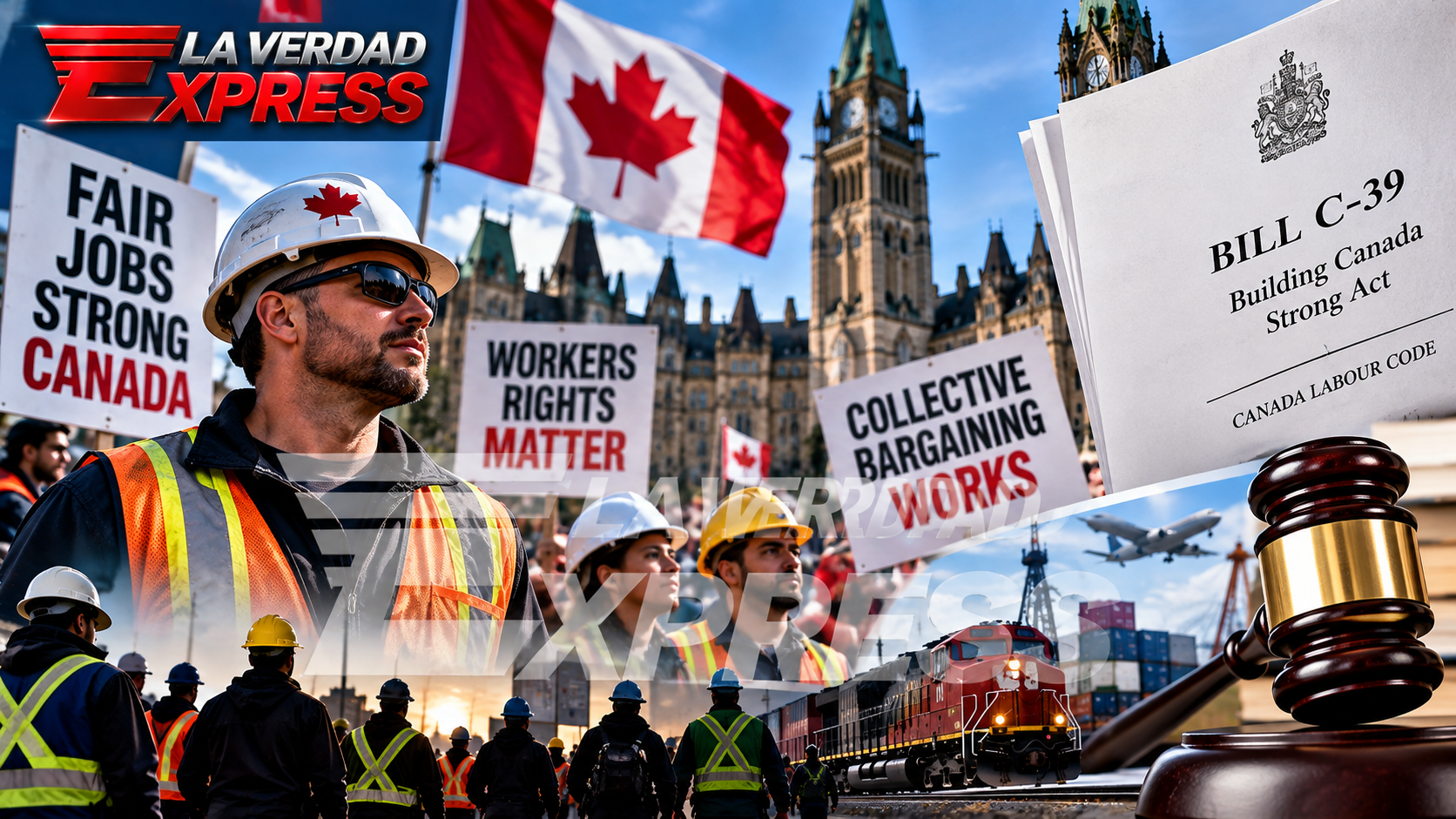
Ottawa says Bill C-39 would strengthen collective bargaining and establish clearer rules for federal intervention, while labour organizations warn the proposed changes could weaken one of workers’ most important bargaining tools.
By La Verdad Express Newsroom
OTTAWA, Ontario — Canada is entering an important debate over the future of labour relations as proposed changes to the Canada Labour Code raise a fundamental question: when negotiations collapse, how far should the federal government be allowed to go before intervening in a legal strike or lockout?
The issue has emerged following the federal government’s introduction of Bill C-39, the Building Canada Strong Act, legislation that includes significant changes to labour relations in federally regulated industries.
Ottawa says the objective is to strengthen collective bargaining, encourage employers and unions to reach agreements before disputes escalate, and establish clearer conditions for government intervention in exceptional labour conflicts.
Labour organizations, however, are raising concerns that some of the proposed changes could give the federal government too much discretion to end strikes when they are considered harmful to Canada’s national interest.
The disagreement goes directly to the balance between two important interests: protecting workers’ ability to bargain collectively and protecting Canadians and the economy from the consequences of major disruptions in critical industries.
More than one million workers could be affected
The changes concern federally regulated private-sector workplaces governed by Part I of the Canada Labour Code.
According to the federal government, those provisions apply to more than one million employees and more than 22,000 employers, including workplaces in sectors such as rail, ports, air transportation, telecommunications, banking and marine transportation.
That makes the debate considerably broader than a disagreement between Ottawa and organized labour.
A major railway, port or airline dispute can quickly affect passengers, businesses, supply chains, international trade and communities far removed from the original bargaining table.
At the same time, the ability to stop working remains one of the most significant sources of negotiating leverage available to unionized workers.
Finding the appropriate balance between those interests is at the centre of Bill C-39.
Ottawa wants more time for agreements before strikes begin
One of the government’s proposed changes would extend the federal conciliation period from the current 60 days to 90 days.
The stated objective is to provide employers and unions with additional time to reach a negotiated settlement before a dispute develops into a strike or lockout.
The legislation would also introduce additional measures for difficult bargaining relationships and require certain parties that have experienced work stoppages or imposed binding settlements to participate in relationship-building work with the Federal Mediation and Conciliation Service.
Ottawa says the existing federal system already resolves approximately 95% of labour disputes without a work stoppage, with assistance from federal mediation and conciliation services. The government argues that additional tools could help address the relatively small number of disputes that become particularly difficult to resolve.
Those provisions have received less attention than another part of the legislation.
That is where the controversy becomes considerably more significant.
The battle over Section 107
At the centre of the disagreement is Section 107 of the Canada Labour Code.
The existing provision gives the federal labour minister broad authority to take measures considered necessary to maintain industrial peace and promote conditions favourable to resolving labour disputes.
Section 107 has been used by federal governments in different ways since it was added to the Code in 1984, including directing the Canada Industrial Relations Board to order operations resumed, impose binding arbitration or extend collective agreements.
Bill C-39 would establish a more detailed process governing when those powers could be exercised.
Under the proposal, a special mediator would first have to be appointed and complete a mandate.
The mediator would then submit a public report to the minister.
After considering that report, the minister would have to form the opinion that a strike or lockout would have a significant adverse national impact before Section 107 powers could be considered.
Once a work stoppage had actually begun, the minister could then direct the Canada Industrial Relations Board to order the resumption of operations or services, temporarily extend an existing collective agreement or establish a binding dispute-resolution process such as arbitration.
The federal government describes this as a clearer and more transparent framework for powers that already exist.
Critics see the issue differently.
Unions fear the meaning of “national interest”
The phrase “national interest” has become one of the most controversial elements of the debate.
Under the proposal, the minister could consider factors including significant effects on Canada’s economy or major social disruption when determining whether a dispute has reached the threshold for intervention.
The assessment would also have to consider workers’ freedom of association and right to strike.
For labour organizations, however, the concern is fundamental.
A strike is intended to create pressure.
Workers temporarily withdraw their labour precisely because disrupting normal operations can give them negotiating leverage with an employer.
The Canadian Labour Congress has argued that the ability to strike is an essential component of meaningful collective bargaining and has expressed concern about allowing the government to determine when the economic consequences of a dispute become sufficiently serious to justify intervention.
Jobs Minister Patty Hajdu has defended the proposal, describing Section 107 intervention as a tool of last resort and arguing that the government’s objective is not to negotiate agreements for the parties but to provide additional mechanisms that encourage employers and unions to reach settlements themselves.
That distinction will likely remain one of the central points of debate as Parliament considers the legislation.
Businesses have another concern: economic disruption
Employers approach the issue from a different perspective.
For companies dependent on ports, railways, airlines and other federally regulated infrastructure, a prolonged work stoppage can create consequences extending well beyond the company and employees directly involved in the dispute.
Supply chains can be interrupted.
Exports can be delayed.
Businesses waiting for components or merchandise can face additional costs.
Travellers can have their plans disrupted.
And Canada’s international trading partners can be affected when goods cannot move efficiently through ports, rail networks and other transportation infrastructure.
The Canadian Chamber of Commerce has supported having additional dispute-resolution mechanisms available when bargaining fails and broader economic interests are at risk.
Some employer organizations have gone further, arguing that Ottawa should have stronger powers to intervene in extraordinary circumstances.
The result is a debate in which unions and employers are looking at the same problem from fundamentally different positions.
A difficult balance for Canada
There is no dispute that prolonged shutdowns of critical infrastructure can create significant economic consequences.
There is also no dispute that the ability to withdraw labour gives workers negotiating power.
The difficult question is where Canada should draw the line between the two.
When does a labour dispute between workers and an employer become a matter of national interest?
And perhaps more importantly:
Who should have the authority to make that determination?
Those questions matter because the answer could shape future negotiations in some of Canada’s most strategically important industries.
If government intervention becomes predictable whenever a strike begins causing substantial economic damage, unions argue that employers could have less incentive to compromise because they may expect Ottawa eventually to intervene.
On the other hand, allowing a dispute involving critical national infrastructure to continue indefinitely could impose substantial costs on Canadians and businesses that have no involvement in the original labour disagreement.
That tension cannot be eliminated simply by legislation.
But the rules established by Parliament will determine how Canada manages it.
What Canadian workers should know
Bill C-39 has been introduced but is not yet final law.
That distinction is important.
The legislation must proceed through the parliamentary process, where its provisions can be examined, debated and potentially amended before becoming law.
Canadians should therefore avoid interpreting the proposal as though Ottawa has already implemented all of these changes.
For workers covered by provincial labour legislation, the direct implications may also differ because Bill C-39’s collective-bargaining reforms concern workplaces under federal jurisdiction.
For federally regulated employees and employers, however, the outcome could be significant.
The legislation could change how long parties negotiate before obtaining the right to strike or lock out, introduce new mediation mechanisms and establish a clearer framework for extraordinary federal intervention.
More than a debate about strikes
The controversy surrounding Bill C-39 ultimately reaches beyond the mechanics of labour negotiations.
It concerns the relationship between workers, employers, government authority and Canada’s broader economic interests.
Canada needs infrastructure capable of moving people and goods reliably.
Businesses need predictability.
Workers need meaningful bargaining rights.
And Canadians need confidence that governments will intervene only when circumstances genuinely justify doing so.
Those objectives do not always point in the same direction.
That is why Parliament’s examination of Bill C-39 deserves close attention.
The question is not simply whether Canada should prevent disruptive strikes.
The larger question is whether the country can protect its economy and critical infrastructure without diminishing the bargaining power that makes collective negotiations meaningful in the first place.
The federal government says its proposal can achieve that balance.
Labour organizations remain unconvinced.
The parliamentary debate will now help determine where that balance ultimately lies.
La Verdad Express will continue following Bill C-39 and its potential consequences for Canadian workers, businesses and the national economy.
La Verdad Express
News that matters to Canada and its communities.














Leave a Reply