


By La Verdad Express Editorial Desk
TORONTO — October 21, 2026
Toronto is heading into the final days of its municipal election with an unexpectedly tight race for mayor, as voters prepare to decide on October 26 who will lead Canada’s largest city through another four years of mounting pressure over housing, transit, affordability and public services.
A new Liaison Strategies poll released October 21 places challenger Brad Bradford at 49% and incumbent Mayor Olivia Chow at 47% among decided and leaning voters. The difference is within the poll’s margin of error, meaning the race remains effectively too close to call. Among all respondents, Bradford registered 42%, Chow 41%, while 14% remained undecided. The survey questioned 1,000 Toronto residents between October 18 and 19 and has a margin of error of ±3.1 percentage points.
The numbers represent a significant tightening compared with earlier stages of the campaign.
In August, Chow held a clear lead in several surveys. A Liaison poll published August 20 had her at 49% among decided and leaning voters compared with 38% for Bradford. The latest numbers suggest the race has changed substantially in the final weeks.
But polling is only one part of the story.
Toronto is also showing unusually strong voter engagement.
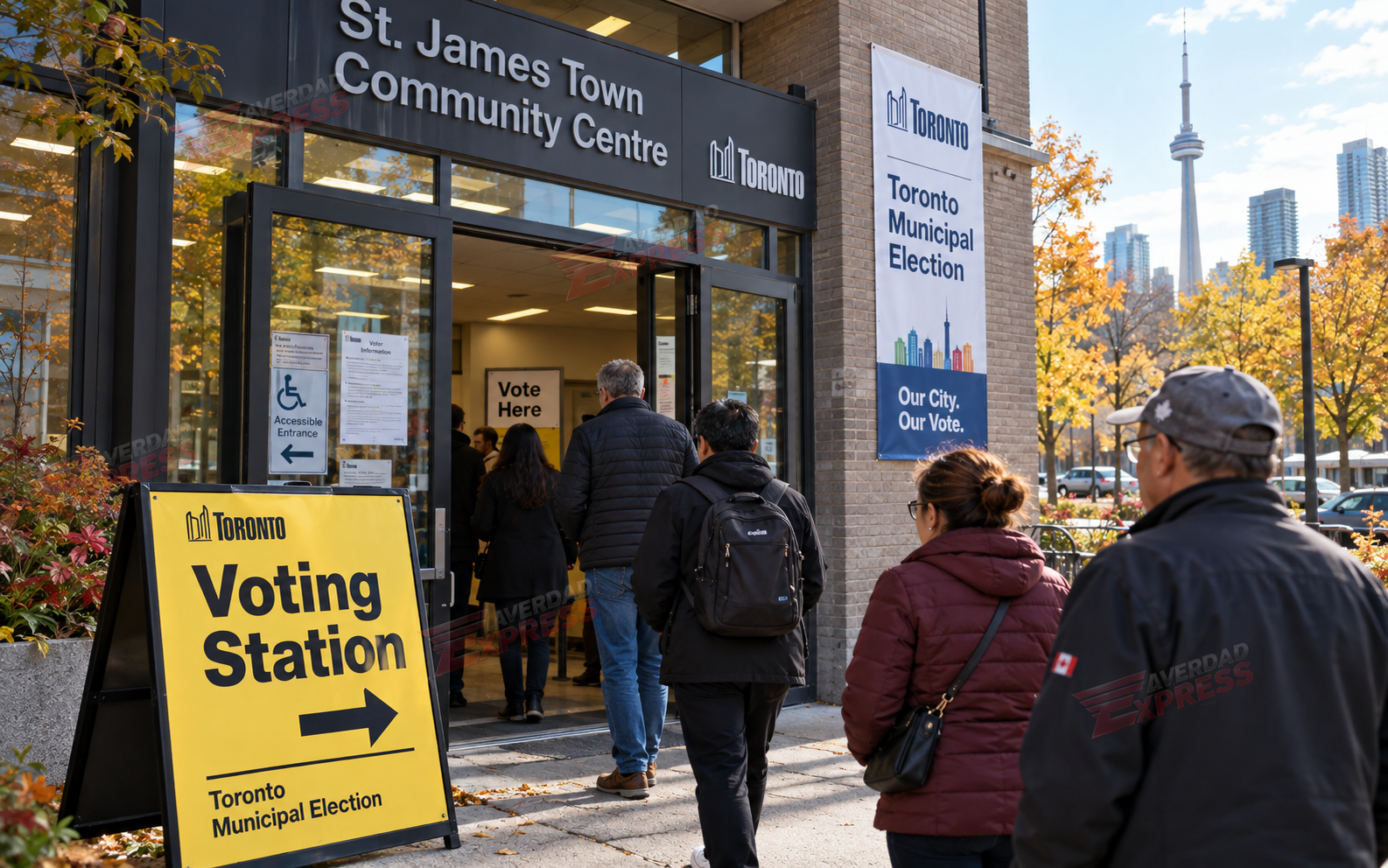
The City of Toronto reported that 222,550 people cast ballots during six days of advance voting, nearly double the 115,911 advance votes recorded in the 2022 municipal election. The final day of advance voting alone drew 53,363 voters.
That increase suggests that the 2026 municipal election is attracting a level of attention that goes beyond the usual local political cycle.

Housing remains at the centre of the election
Housing is one of the clearest dividing lines between the two leading candidates.
Chow has emphasized tenant protections and rental affordability, including proposals to expand the city’s RentSafeTO program and support the creation of new below-market rental units.
Bradford has focused more heavily on home ownership and reducing transaction costs, including a proposal to provide rebates on Toronto’s municipal land transfer tax for qualifying home purchases.
Those differences reflect two major realities inside Toronto.
The city has a large population of renters facing rising costs and housing insecurity, while many homeowners and prospective buyers are concerned about affordability, taxes and the cost of entering the housing market.
The latest polling also suggests that this divide is appearing in voter preferences: Chow performs more strongly among renters, while Bradford draws greater support from homeowners.
Transit is another defining issue
Toronto’s transit system has also become a central election issue.
Chow has emphasized affordability, including maintaining frozen TTC fares and pursuing fare caps, while also pointing to federal and provincial funding secured for transit infrastructure.
Bradford has placed stronger emphasis on safety and reliability, proposing measures including platform edge doors, additional police presence in subway stations and refunds for significant delays.
The debate reflects a broader challenge for the next mayor.
Toronto’s transit system faces pressure not only from service and safety concerns but also from long-term financial sustainability.
The next administration will need to balance service improvements with the reality that the city cannot indefinitely expand spending without finding stable revenue.
The election is about more than personalities
Much of the attention will naturally focus on Chow and Bradford.
But the deeper question facing Toronto is not simply which candidate wins.
It is what kind of city voters believe Toronto should become.
Housing affordability, transit reliability, public safety, taxation and infrastructure are no longer isolated municipal issues. They directly affect whether people can continue living, working and raising families in the city.
Toronto’s growth has created extraordinary economic opportunities, but it has also produced growing pressure on basic services and household budgets.
The next mayor will inherit a city that is larger, more expensive and more politically demanding than it was only a few years ago.
A surge in participation could matter
The record level of advance voting may prove to be one of the most important elements of this election.
High participation does not automatically favour any particular candidate, and it should not be interpreted as evidence of a specific outcome.
What it does show is that more residents are choosing to participate before election day.
That matters in municipal politics, where turnout has traditionally been lower than in federal or provincial elections.
Election Day is Monday, October 26, with voting locations open from 10 a.m. to 8 p.m. Toronto voters must cast their ballots at their assigned voting place unless they already voted through an approved advance or mail-in option.
Across Ontario, municipal council and school board elections are also taking place on October 26.
La Verdad Express Analysis
Toronto’s mayoral election has evolved into something larger than a contest between two political figures.
It is becoming a referendum on how residents experience the city.
For renters, the issue may be housing costs and tenant security.
For homeowners, it may be taxes, affordability and property values.
For commuters, transit reliability can determine whether daily life feels manageable.
For businesses, the central concern may be whether Toronto remains competitive while operating costs continue to rise.
These priorities do not always point in the same direction.
That is precisely why this election matters.
The next mayor will have to govern a city where different groups are experiencing Toronto in very different ways.
A close election also creates an important responsibility for voters: to look beyond campaign slogans and examine how proposals would actually be funded, implemented and measured.
Toronto does not simply need promises.
It needs workable policy.
With only days remaining before October 26, the race appears increasingly competitive, voter participation is already elevated and the city’s direction is very much at stake.
The final decision now belongs to Toronto’s voters.






Leave a Reply