

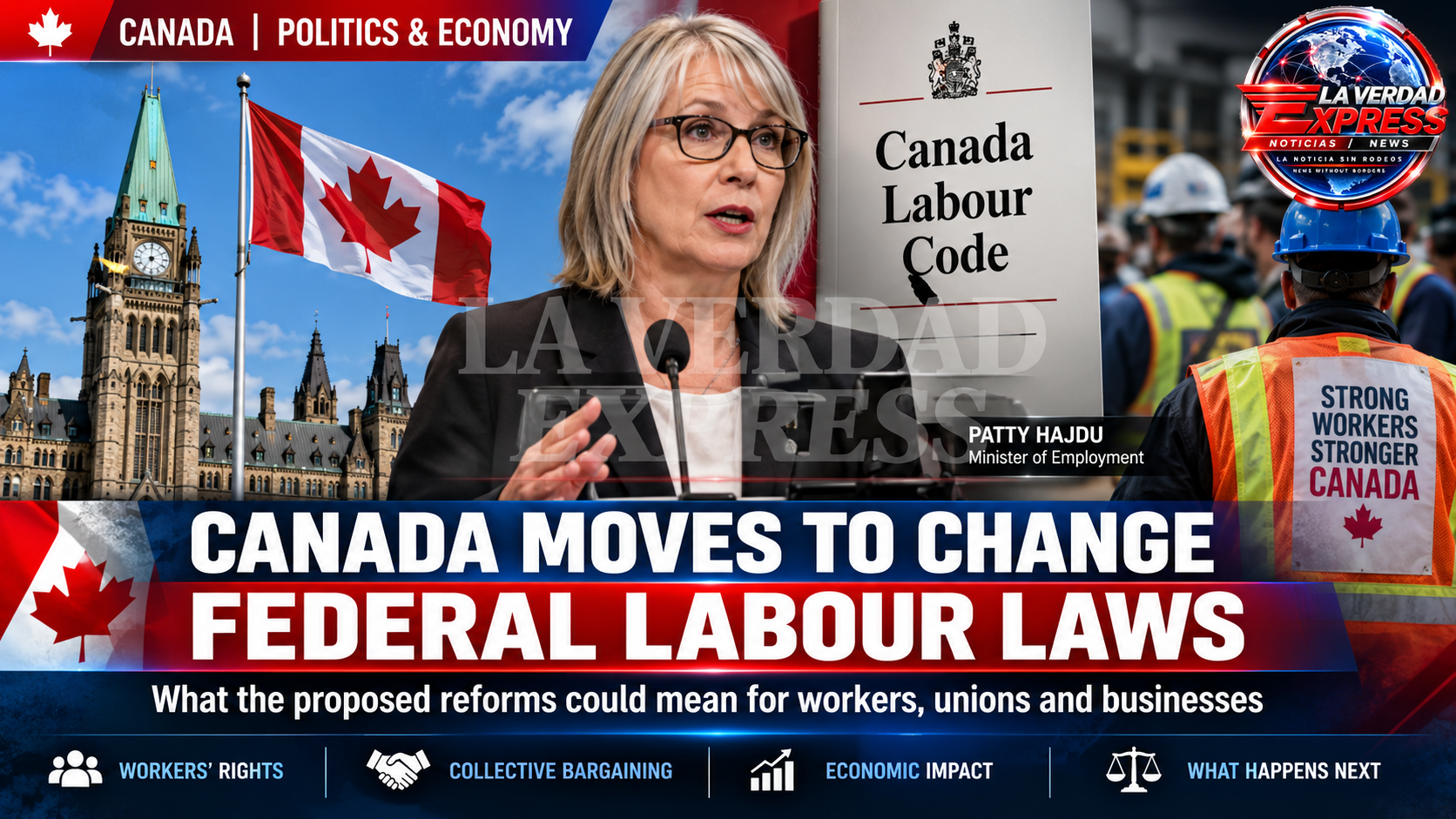
Bill C-39 would expand dispute-resolution mechanisms in federally regulated workplaces, while unions question how Ottawa could use its authority to intervene in major labour disputes.
OTTAWA, Ontario — Canada is entering a significant debate over the future of collective bargaining after the federal government introduced legislation that would modify key provisions of the Canada Labour Code and establish a more defined process for government intervention in labour disputes considered to have a significant national impact. Canada
Bill C-39, known as the Building Canada Strong Act, was introduced by the federal government on September 21. Its labour provisions would affect federally regulated industries and workplaces, a sector covering more than one million employees and more than 22,000 employers, according to federal government figures. Canada
The proposal arrives at a sensitive moment for Canada’s economy. Recent years have brought high-profile labour disputes affecting transportation, postal services and other sectors where prolonged disruptions can have consequences extending well beyond the workers and employers directly involved.
A new process before federal intervention
One of the most consequential elements involves Section 107 of the Canada Labour Code.
Under the proposed legislation, a special mediator could be appointed during difficult negotiations. If the dispute remained unresolved, the mediator would produce a public report outlining the outstanding issues.
Before the federal labour minister could consider using Section 107 powers in a dispute with significant national consequences, the special mediator would have to complete that process and submit the report. The government would also conduct an assessment of the potential national impact of the labour disruption. Canada
If the required conditions were satisfied and a work stoppage had begun, the minister could direct the Canada Industrial Relations Board to order operations or services to resume, temporarily extend an existing collective agreement or establish a binding dispute-resolution mechanism such as arbitration. Canada
The government describes these powers as measures intended for exceptional circumstances rather than a replacement for collective bargaining.
Jobs Minister Patty Hajdu has argued that greater transparency—including public reporting on unresolved bargaining issues—could increase accountability and encourage employers and unions to reach agreements themselves. Global News
Unions raise concerns over the right to strike
The proposal, however, has generated significant opposition from organized labour.
Canadian Labour Congress president Bea Bruske has argued that the ability of workers to withdraw their labour is itself an important component of Canada’s national interest, allowing employees to negotiate wages, workplace safety and job security. Labour representatives also question whether the concept of “national interest” could give the government too much discretion to terminate lawful strikes. Global News
The federal government’s position is different. Its official documentation says the framework would require consideration of the protected right to strike alongside potential national economic disruption, broader social and public consequences, and possible alternatives or mitigation measures. Canada
That distinction will likely be central to the debate: when does the economic and social impact of a labour dispute become significant enough to justify federal intervention?
Changes go beyond strikes
Bill C-39 contains other labour measures that could receive less attention but potentially affect a substantial number of workers.
The government proposes extending the conciliation period from 60 to 90 days, providing more time for negotiations before parties obtain the right to strike or lock out. It also proposes mandatory relationship-building work following certain disputes and additional resources for the Canada Industrial Relations Board. Canada
Ottawa has also announced plans to add 100 health and safety officers, which the government says would increase federal inspection capacity by approximately 70 per cent, as well as 26 additional staff at the Canada Industrial Relations Board and stronger enforcement against worker misclassification. Canada
The proposals follow consultations conducted during the spring and summer of 2026 involving unions, labour organizations, employers, employer associations and Indigenous organizations. Canada
The La Verdad Express perspective
The challenge for Parliament is not simply choosing between workers and businesses.
Canada needs reliable transportation networks, functioning supply chains and economic stability. Businesses and consumers can face substantial consequences when critical services remain disrupted for extended periods.
At the same time, collective bargaining depends on workers and employers retaining meaningful negotiating power. A mechanism designed to protect the national interest therefore requires clearly defined safeguards, transparency and accountability if it is to maintain public confidence.
The real test of Bill C-39 will be found in the details: how “significant national impact” is interpreted, how much discretion remains with the government, and whether the safeguards surrounding intervention are strong enough to preserve meaningful collective bargaining.
For workers, employers and Canadians who depend on federally regulated services, this debate deserves close attention.
Bill C-39 is currently a proposal before Parliament. Its introduction does not mean that these changes have already become Canadian law. Canada
La Verdad Express
A Newspaper of Insight, Purpose and Truth.









Leave a Reply